
Star Tracker – Mobile Sky Map
PYOPYO Studio
April 06, 2026
36.11 MB
1.6.115
Varies with device

Star Tracker MOD APK Info
The Star Tracker Mod APK offers an enhanced stargazing experience by providing the “Pro Unlocked” status immediately upon installation. Unlike the standard free version, which limits access to advanced tools and displays advertisements, this modified package grants users full access to premium features such as the Time Machine for simulating celestial movements across different eras, the precise 3D Compass mode for accurate navigation, and the complete catalog of deep-sky objects including galaxies and nebulae, all without requiring in-app purchases.
Images

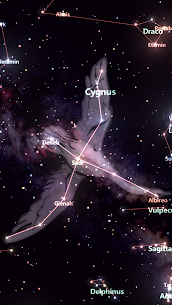


Description
For millennia, humanity has looked up at the night sky with a mix of awe and curiosity. The stars have guided sailors, marked the changing seasons, and inspired countless myths. However, in the modern age, the connection between the average person and the cosmos has been somewhat severed by light pollution and the complexities of astronomical charts. Enter Star Tracker, a mobile application developed by PYOPYO Studio that promises to bridge this gap, turning your smartphone into a powerful, augmented-reality window into the universe.
Table of Contents
Unlike the complex paper star charts of the past or expensive telescope setups, Star Tracker offers a “point-and-shoot” simplicity that appeals to everyone from curious children to amateur astronomers. It is more than just a map; it is a real-time simulation of the celestial sphere that fits in your pocket. This article serves as an exhaustive guide and review of the Star Tracker app, exploring its features, technical mechanics, user interface, and its standing in the crowded market of astronomy apps.
1. What is Star Tracker?
At its core, Star Tracker is a mobile planetarium. It utilizes the sophisticated sensor array built into modern smartphones—specifically the magnetometer (digital compass), accelerometer, and gyroscope—to determine the device’s precise orientation in three-dimensional space. By combining this orientation data with the user’s GPS coordinates and the current time, the app calculates exactly which celestial bodies are currently visible in the direction the user is facing.
When you hold your phone up to the sky, the screen becomes a digital overlay, revealing stars, constellations, planets, and deep-sky objects that might be invisible to the naked eye due to city lights or atmospheric conditions. It removes the guesswork from stargazing. You no longer need to wonder, “Is that bright dot Venus or Jupiter?” or “Where exactly is the belt of Orion?” Star Tracker answers these questions instantly.
The Target Audience
- Casual Stargazers: People who want to quickly identify a bright star or planet during a backyard hang-out.
- Campers and Hikers: Outdoor enthusiasts who often find themselves in dark-sky preserves without internet access.
- Parents and Educators: Those looking for an interactive tool to introduce children to the wonders of astronomy without a steep learning curve.
- Astrophotography Beginners: While not a tool for controlling mounts, it helps in planning shots by showing where the Milky Way or specific constellations will rise.
2. Getting Started: Installation and Calibration
Installation and Permissions
The app is lightweight compared to some of its competitors (typically under 50MB), making it accessible even for older devices with limited storage. Upon first launch, Star Tracker requests two primary permissions:
- Location (GPS): Crucial for calculating the local sidereal time and the position of stars relative to your specific longitude and latitude.
- Sensors: Access to the gyroscope and compass is non-negotiable for the AR features to function.
The Calibration Ritual
One of the most critical steps in using any AR astronomy app, including Star Tracker, is calibration. Users often report that the app points “in the wrong direction” or drifts. This is rarely a software bug but rather a hardware limitation of mobile magnetometers, which are highly susceptible to magnetic interference.
How to Calibrate for Best Results:
- Remove Interference: Metal phone cases, magnetic car mounts, and pop-sockets with metal rings must be removed. These distort the magnetic field reading, causing the “North” in the app to deviate from True North.
- The Figure-8 Motion: Before relying on the app for precise identification, wave the phone in a “figure-8” motion in the air. This forces the sensors to reset their axes.
- 3-Axis Rotation: Alternatively, rotate the phone 360 degrees along all three axes (X, Y, and Z) to ensure the gyroscope and magnetometer are synced.
3. Key Features: A Deep Dive
Real-Time Augmented Reality (AR) Tracking
The hallmark feature of Star Tracker is its “Smooth Motion Flow.” PYOPYO Studio highlights their cutting-edge signal processing technique, which differentiates this app from many jittery competitors. When you pan your phone across the sky, the star map moves fluidly. There is very little lag between your hand movement and the screen’s response, maintaining the illusion that you are looking through a window rather than at a screen.
The “Offline” Advantage
In an era where apps constantly demand data connections, Star Tracker stands out by being fully offline. All data—star positions, constellation art, and deep-sky object coordinates—is stored locally on the device.
- Why this matters: True stargazing often happens in remote areas (National Parks, deserts, high mountains) where cellular signals are weak or non-existent. Star Tracker ensures that your planetarium works perfectly even in “Airplane Mode,” which also helps conserve battery life during long observation sessions.
The Celestial Database
The app’s database is robust enough for naked-eye observation and binocular users:
- Stars: Over 8,000 stars are cataloged, covering everything visible to the naked eye (up to magnitude 6.5) and slightly beyond.
- The Solar System: The Sun, Moon, and all major planets are tracked in real-time. The app accurately depicts the phase of the Moon and the current position of planets along the ecliptic.
- 88 Constellations: The app supports the official 88 constellations recognized by the International Astronomical Union (IAU).
- Deep Sky Objects (DSO): The app includes the Messier catalog—a list of 110 nebulae, galaxies, and star clusters. While the free version offers a preview (e.g., the Andromeda Galaxy, Orion Nebula), the Pro version unlocks the full catalog.
Visual Aesthetics and Constellation Art
The visual presentation in Star Tracker is distinct. It uses a clean, high-contrast style.
- Zodiac Art: The 12 Zodiac constellations (Aries, Taurus, Gemini, etc.) feature elaborate, mythological artwork overlaying the stars. This is particularly engaging for children or those interested in the astrological history of the stars.
- Star Magnitude Representation: Brighter stars are rendered as larger, glowing orbs, mimicking how they appear to the human eye, while fainter stars are smaller dots. This realistic sizing helps users correlate the screen image with the actual sky.
4. Free vs. Pro: Is the Upgrade Worth It?
Star Tracker operates on a “Freemium” model. The free version is fully functional but acts as a “Lite” experience. The Pro version (typically a one-time purchase of around $2.99 – $3.99) unlocks the full potential of the software.
The Free Version
The free version allows you to:
- Track stars and planets in real-time.
- View the 88 constellations (with lines connecting the stars).
- See artwork for the 12 Zodiac signs.
- View 6 famous Deep Sky Objects.
- Limitation: It is ad-supported. You may see banner ads or interstitial pop-ups, which can be jarring and ruin your night vision.
The Pro Version Features
Upgrading removes the ads and unlocks several professional-grade tools:
1. The Time Machine
This is arguably the most powerful feature for planning observations. A dedicated slider and menu allow you to scroll forward or backward in time.
- Use Case: You want to know when Saturn will rise tonight. Instead of waiting, you use the Time Machine to fast-forward the sky to 10:00 PM and see where Saturn will be.
- Educational Use: You can rewind thousands of years to see how the Pole Star has changed due to the precession of Earth’s axis.
2. The 3D Compass
In the Pro version, an AR Compass overlay appears, indicating the cardinal directions (N, S, E, W) and the user’s elevation angle. This adds a layer of technical precision, helping users understand coordinates like Azimuth (compass direction) and Altitude (height above the horizon).
3. Night Mode
Stargazing requires “dark adaptation”—a chemical process in the eye that takes 20-30 minutes to allow you to see faint stars. Looking at a bright white phone screen instantly destroys this adaptation.
- The Solution: Star Tracker Pro’s Night Mode turns the entire interface red. Red light has a longer wavelength and does not stimulate the rods in the human eye as strongly as white or blue light, preserving your night vision while you use the app.
4. Search Function & Full DSO Catalog
The Pro version allows you to type in the name of a star, planet, or constellation. An arrow will then appear on the screen to guide your phone toward the object—a “manual GoTo” system. It also unlocks the full catalog of Messier objects, essential for users with binoculars or small telescopes hunting for star clusters and galaxies.
5. User Interface (UI) and Experience
Minimalist Design
The UI of Star Tracker is designed to “get out of the way.” When you lift the phone towards the sky, the menus automatically fade away, leaving only the star field. This immersion is central to the app’s philosophy.
- Touch Interactions: Touching the screen pauses the tracking (entering “Un-track mode”), allowing you to manually swipe around the sky map to see what is below the horizon or in a different direction. A “re-center” button quickly snaps the view back to the live sensor data.
Audio Experience
The app features a background track of ethereal, ambient music. While some users find it soothing and atmospheric, enhancing the sense of wonder, others may find it repetitive. Fortunately, the sound can be toggled off in the settings for those who prefer the silence of the night.
Stability and Battery Life
Because the app relies heavily on the GPU for rendering 3D star fields and the sensors for tracking, it can be battery-intensive. However, compared to apps that download map data on the fly, Star Tracker is relatively efficient. The offline nature means the radio (cellular/WiFi) can be turned off, significantly extending battery life during field use.
6. Technical Underpinnings: How It Works
It is important to clarify that Star Tracker (the app) is different from a mechanical Star Tracker (a motorized mount for cameras). The app simulates the sky; the mount physically moves a camera to counter Earth’s rotation.
Sensor Fusion
The app uses a technique called sensor fusion.
- Accelerometer: Detects gravity to know which way is “down.” This determines the altitude (how high up you are looking).
- Magnetometer: Detects magnetic North. This determines the Azimuth.
- Gyroscope: Detects rotational velocity. This smooths out the jitter from shaky hands, providing the “fluid motion” the developers boast about.
Note on Accuracy: The app is only as accurate as the phone’s sensors. If your phone has a cheap or damaged compass, the star alignment will be off. The app includes a manual offset feature in the settings (in some versions) or relies on the calibration motions mentioned earlier to correct this.
7. Comparative Analysis
How does Star Tracker stack up against the titans of the industry?
Star Tracker vs. Star Walk 2
- Visuals: Star Walk 2 is often considered more “beautiful” with water effects, atmospheric glow, and 3D models of satellites. Star Tracker is more utilitarian and sharp.
- Performance: Star Tracker is often faster on older hardware because it lacks the heavy graphical shaders of Star Walk 2.
- Price: Star Tracker is generally cheaper to unlock fully than the various add-on packs required for Star Walk 2 or Sky Guide.
Star Tracker vs. Stellarium Mobile
- Data: Stellarium is the gold standard for accuracy and database size. It is a serious tool for serious astronomers.
- Ease of Use: Star Tracker is far easier for a beginner to pick up and use instantly. Stellarium has a steeper learning curve and a more cluttered interface.
- Verdict: Use Star Tracker for quick identification and fun. Use Stellarium if you are setting up a telescope and need precise coordinate data for faint variable stars.
8. Educational and Practical Scenarios
Scenario A: The Family Camping Trip
You are camping in the Rockies. The fire is dying down, and the sky is a blanket of diamonds. Your child points to a bright red star and asks what it is.
- Using Star Tracker: You open the app (no internet needed). You point it at the star. The app identifies it as Antares in the constellation Scorpius. You tap the constellation to show your child the artwork of the Scorpion, explaining the myth. You then use the Time Machine to show where the moon will be in 3 hours.
Scenario B: The Meteor Shower Hunt
It is the night of the Perseids. You need to know where the “radiant” (the point where meteors originate) is.
- Using Star Tracker: You search for the constellation Perseus. The guide arrow directs you to face Northeast. You can now set up your lawn chair facing the correct direction to maximize your meteor count.
Scenario C: Photography Planning
You want to photograph the Milky Way core.
- Using Star Tracker: You use the manual scroll or Time Machine to fast forward to 3:00 AM. You see that the constellation Sagittarius (which marks the galactic center) will be rising over the specific mountain ridge you are facing. You can plan your shoot time accordingly without waiting up all night.
9. Critique and Areas for Improvement
While excellent, Star Tracker is not perfect.
- Limited Object Info: Clicking on a star provides basic info (Name, Azimuth, Magnitude). It lacks the encyclopedic descriptions, distance in light-years, spectral class, and history found in apps like SkySafari.
- Sensor Drift: Like all AR apps, it drifts. Users must frequently recalibrate in magnetic environments.
- UI Modernization: The interface, while functional, feels slightly dated compared to the sleek, transparent glass aesthetics of modern iOS design guidelines.
- No Satellite Tracking: Unlike some competitors, Star Tracker focuses on deep space and natural bodies, largely ignoring the ISS, Starlink, and other satellites.
Conclusion
Star Tracker by PYOPYO Studio successfully delivers on its promise: it is a robust, offline-capable, and user-friendly pocket planetarium. It strips away the intimidation factor of astronomy, replacing complex charts with an intuitive “window” to the cosmos.
While it may lack the encyclopedic depth of Stellarium or the graphical polish of Star Walk 2, it strikes a perfect balance for the vast majority of users. Its offline functionality makes it an essential survival tool for the outdoors, and its smooth tracking engine provides one of the most responsive AR experiences on the market.
For the price of a cup of coffee, the Pro version is a worthy investment for anyone who has ever looked up at the night sky and wondered, “What is that?”
What's new
1.6.115:
- Added notification history: access your most recent 20 notifications via Settings → Notifications.
1.6.111:
- Fix the white screen issue for certain devices.
==Please REMOVE metal case or magnetic cover to avoid motion sensor interference==
Recent updates:
- Add Setting menu, more settings are coming.
- Fix the issue that sometimes need relaunch to take effects after make purchase.
- Enable more Messier Objects and Constellation Arts for free version.
- Introduce Meteor Shower
Download links
An ad will pop up before the download. Close it, click download again—ads keep us going, thanks!


