
Spaceflight Simulator

Spaceflight Simulator Info
Images
Related apps




Description
Imagine having the entirety of the solar system scaled down and placed directly into your pocket, complete with the uncompromising laws of real-world orbital mechanics. Spaceflight Simulator APK, developed by Stefo Mai Morojna, is not just a casual mobile game; it is an incredibly robust, physics-driven sandbox that transforms you into the lead engineer, mission director, and astronaut of your very own aerospace program.
Table of Contents
Instead of relying on arcade-style controls or predetermined flight paths, this game hands you a warehouse full of rocket parts and a scientifically accurate physics engine. Your objective is entirely self-determined. Whether you want to place a rudimentary satellite into Low Earth Orbit (LEO), construct a sprawling modular space station, or execute a multi-stage manned mission to the surface of Mars and back, the only limits are your engineering ingenuity and your understanding of gravity.
If you have ever looked at the night sky and wondered about the sheer mechanical force and mathematical precision required to leave our atmosphere, this game provides the most accessible, yet mechanically deep, simulation available for mobile devices.
What Makes Spaceflight Simulator Stand Out?
The mobile gaming market is flooded with space-themed titles, but the vast majority of them lean heavily into science fiction. They feature warp drives, laser battles, and physics that behave more like airplanes in a vacuum. Spaceflight Simulator strips away the fantasy and replaces it with the awe-inspiring reality of actual rocket science.
The game is built on a custom physics engine that accurately calculates mass, thrust, aerodynamic drag, and gravity. Every single component you snap onto your rocket directly affects its flight characteristics. If your rocket is too heavy, it will not clear the launchpad. If it is aerodynamically unstable, it will flip over and disintegrate in the lower atmosphere.
This commitment to realism is what makes every successful launch, orbit, and landing feel like a monumental achievement. The game respects your intelligence, refusing to hold your hand, while simultaneously providing an incredibly intuitive interface that makes learning complex astrophysical concepts highly engaging.
Deep Dive: The Vehicle Assembly Building
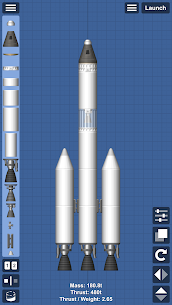
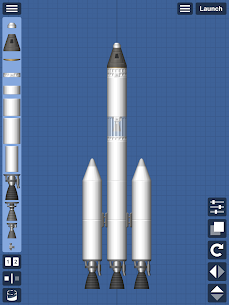
Your journey to the stars begins in the assembly building. This is where the core gameplay loop of Spaceflight Simulator takes root. The game provides a highly intuitive drag-and-drop interface, allowing you to piece together spacecraft from a comprehensive catalog of modular components.
Choosing Your Propulsion Systems
Engines are the heart of your spacecraft, and you are provided with several distinct options, each designed for a specific phase of flight. You have massive, high-thrust engines designed specifically to punch through the thick lower layers of Earth’s atmosphere. These engines burn through fuel at an alarming rate but provide the necessary brute force to overcome gravity.
Once you are in the vacuum of space, you will need to switch to vacuum-optimized engines. These engines have lower thrust but are far more fuel-efficient, allowing you to perform orbital maneuvers and interplanetary transfers without carrying unnecessary mass. Understanding the difference between sea-level thrust and vacuum efficiency is your first major lesson in aerospace engineering.
Managing Fuel and Mass
Fuel tanks come in various sizes and shapes, and managing them is a constant balancing act. Every drop of fuel you add increases your potential range, but it also exponentially increases your rocket’s total mass. This means you need bigger engines to lift the heavier rocket, which in turn require even more fuel.
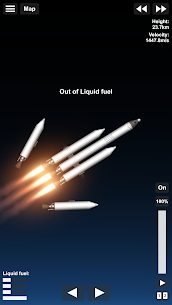
This is a practical demonstration of the tyranny of the rocket equation. To circumvent this, you must learn to build multi-stage rockets. By attaching decouplers, you can jettison empty fuel tanks and heavy atmospheric engines once they are no longer needed. Shedding this dead weight makes the remaining stages of your spacecraft significantly more efficient.
Aerodynamics and Payloads
Your payload—whether it is a small robotic rover, a communications satellite, or a crewed capsule—needs to be protected during the violent ascent through the atmosphere. Aerodynamic fairings are crucial here.
By encasing your payload in a sleek, pointed fairing, you drastically reduce air resistance. Once you reach the vacuum of space, you can deploy the fairing, revealing your payload and shedding the unnecessary weight before circularizing your orbit.
Mastering Orbital Mechanics and Flight
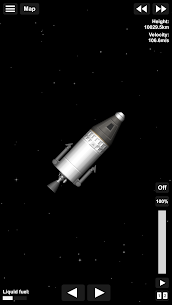
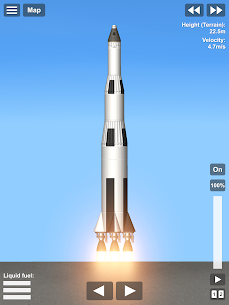
Building a capable rocket is only half the battle; flying it requires an entirely different set of skills. Spaceflight Simulator does not use simplified controls. You must manually manage your throttle, monitor your fuel levels, and steer your vessel using a navball and a beautifully rendered map screen.
The Ascent and Gravity Turn
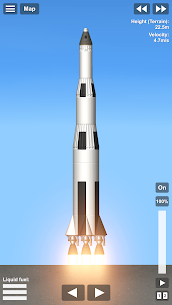
Hitting the launch button is thrilling, but a successful flight requires immediate focus. You cannot simply fly straight up if you want to stay in space. While flying straight up gets you out of the atmosphere, gravity will eventually pull you right back down.
To achieve orbit, you must execute a gravity turn. As your rocket ascends, you gradually pitch it over, building up immense horizontal velocity. The goal is to move sideways so fast that as gravity pulls you down, the curvature of the Earth falls away beneath you at the exact same rate.
Navigating the Map View
The map view is where the true strategic depth of Spaceflight Simulator reveals itself. Here, you can see your trajectory plotted out as a line curving around the planet. You will become intimately familiar with terms like “Apoapsis” (the highest point of your orbit) and “Periapsis” (the lowest point).
By burning your engines at specific points in your orbit, you can alter your trajectory. Burning prograde (the direction of travel) raises the opposite side of your orbit, while burning retrograde (against the direction of travel) lowers it. Mastering these maneuvers is essential for reaching other planets.
Docking and Orbital Assembly
One of the most challenging and rewarding mechanics in the game is orbital docking. You can launch multiple rockets into similar orbits, carefully match their velocities, and physically connect them using docking ports.
This allows you to construct massive, sprawling space stations in orbit, piece by piece. It also enables you to assemble massive interplanetary vessels that would be far too heavy to launch from the surface of the Earth in a single piece.
Exploring a True-to-Scale Solar System
The universe in Spaceflight Simulator is staggeringly vast. The distances between celestial bodies are realistically scaled, meaning interplanetary travel requires careful planning, precise timing, and a solid understanding of transfer windows.
Conquering the Earth-Moon System
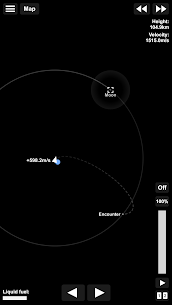
Your first major milestone after achieving orbit will likely be reaching the Moon. This requires waiting for the Moon to be in the correct position relative to your spacecraft, performing a precise transfer burn, and then slowing down enough to be captured by lunar gravity.
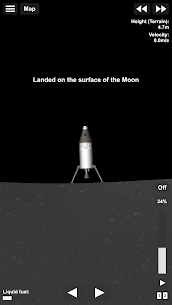
Landing on the Moon introduces new challenges. With no atmosphere to deploy parachutes, you must rely entirely on powered descent. You have to perfectly balance your engine throttle to cancel out your falling velocity, touching down softly on the lunar surface before running out of fuel.
Braving the Atmospheres of Venus and Mars
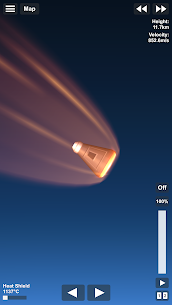
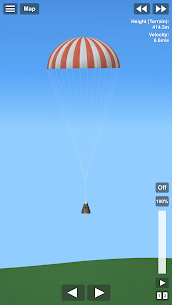
Venturing beyond the Earth-Moon system opens up entirely new gameplay dynamics. Mars features a thin atmosphere. While it is not thick enough to slow you down completely with parachutes alone, it does provide some aerodynamic braking. A successful Mars landing usually requires a combination of heat shields to survive atmospheric entry, parachutes to slow down, and a final propulsive burn to touch down safely.
Venus, on the other hand, presents a literal pressure cooker of a challenge. Its atmosphere is incredibly dense. Entering the Venusian atmosphere requires heavy-duty heat shields to prevent your spacecraft from burning up instantly. The thick atmosphere makes landing easy via parachutes, but the intense gravity and atmospheric drag make launching back off the surface of Venus one of the hardest challenges in the game.
System Requirements and Optimization
Despite its incredible depth and physically accurate simulation, Spaceflight Simulator is remarkably well-optimized. The developer has ensured that the game runs smoothly across a massive variety of hardware configurations.
You do not need a flagship mobile device to calculate complex orbital mechanics. The minimalist, clean 2D art style ensures that the graphical overhead remains low, allowing the device’s processor to focus entirely on the physics calculations. Whether you are playing on a brand-new tablet or a budget smartphone from a few years ago, you can expect fluid framerates and responsive controls.
Essential Tips for New Rocket Engineers
Starting your first space program can be daunting. The physics engine does not forgive mistakes, but learning from failure is part of the fun. Here are a few vital tips to keep in mind.
- Start Small: Do not try to build a massive Mars rocket on your first attempt. Start by building a simple, single-stage suborbital rocket to understand how the controls and staging work.
- Embrace Symmetry: An unbalanced rocket is an uncontrollable rocket. Always use the symmetry tool in the assembly building to ensure your side boosters and aerodynamic fins are perfectly balanced.
- Watch Your Thrust-to-Weight Ratio (TWR): If your TWR is below 1.0, your rocket will not lift off the pad. You want a TWR of around 1.2 to 1.5 for a smooth, efficient ascent through the lower atmosphere.
- Use Reaction Control Systems (RCS): For precise maneuvers in the vacuum of space, especially during docking procedures, rely on RCS thrusters. Main engines are often too powerful for delicate adjustments.
Conclusion
Spaceflight Simulator is a rare triumph in mobile gaming. It manages to take a highly complex, mathematically demanding subject—aerospace engineering and orbital mechanics—and distill it into a deeply engaging, profoundly rewarding sandbox experience.
It is a game that teaches you the fundamental laws of the universe simply by letting you play within them. Every explosion on the launchpad is a lesson in structural integrity; every missed planetary encounter is a lesson in orbital timing. By the time you successfully plant a rover on the surface of Mars, you will have developed a genuine, intuitive understanding of how actual spaceflight works. Download it today from our secure servers, head into the assembly building, and start building your path to the stars.
What's new
Texture rework for: Mercury, Venus, Earth, Mars, Phobos, Deimos Water: Added water to Earth Parts now have a density value New planets: Ceres Saturn, Pan, Enceladus, Titan, Iapetus Uranus, Miranda, Ariel, Titania Neptune, Proteus, Triton Pluto, Charon If you already own the full bundle, all new planets are included completely for free!
Download links
An ad will pop up before the download. Close it, click download again—ads keep us going, thanks!


