
Mob Control

Images




Related apps





Description
The Evolution of Tower Offense in the Hybrid-Casual Era
The mobile gaming landscape of the mid-2020s has been defined by the rapid maturation of the “hybrid-casual” genre—a design philosophy that merges the instant accessibility of hyper-casual mechanics with the depth and retention systems of mid-core strategy games. Standing at the forefront of this evolution is Mob Control, developed by the French publishing giant Voodoo. Since its initial release in 2021 and its subsequent expansion onto PC and console platforms via QubicGames in 2024 and 2025, Mob Control has transcended its origins as a simple “runner” game to become a complex ecosystem of tower defense, resource management, and competitive esports-lite features.
Table of Contents
This report provides an exhaustive, 2025-updated analysis of Mob Control. It dissects the game’s core physics engine, the strategic intricacies of its Armory, the economic impact of its “God Tier” competitive scene, and the significant operational shifts driven by high-profile IP collaborations with Hasbro’s Transformers. By examining player sentiment, statistical data, and game design principles, this document serves as a definitive guide to understanding the mechanisms that have driven Mob Control to over 130 million downloads and $30 million in revenue.
The “Oddly Satisfying” Core Loop
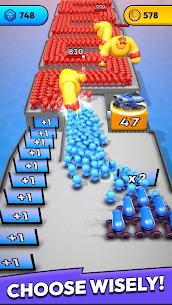
At its most fundamental level, Mob Control capitalizes on the psychological appeal of “oddly satisfying” visual feedback. The primary loop involves launching stickman units (Mobs) from a cannon, passing them through multiplier gates to exponentially increase their numbers, and overwhelming enemy defenses through sheer volume.1 However, beneath this visually simple premise lies a rigorous mathematical engine. The game is not merely about shooting; it is about rapid-fire arithmetic and flow dynamics. The player must instantaneously calculate pathing efficiency—deciding whether a +10 additive gate is superior to a x2 multiplicative gate based on the current flow rate of their cannon.
Market Position and Cross-Platform Expansion
While Voodoo dominates the mobile charts, the strategic partnership with QubicGames to bring Mob Control to Nintendo Switch, PlayStation 4/5, and Steam marks a significant pivot toward cross-platform ubiquity. The PC and console versions, often sold as “Complete Editions” or with DLC bundles, offer a premium, ad-free experience that contrasts sharply with the ad-supported monetization model of the mobile version. This bifurcation creates two distinct player experiences: the mobile “grind” focused on live-ops events and ad consumption, and the console “arcade” experience focused on local multiplayer and fixed progression.
Core Gameplay Mechanics and Physics Engines
To master Mob Control, one must first understand the physics engine that governs the battlefield. Unlike traditional strategy games where units have complex pathfinding AI, mobs in Mob Control function more like fluid particles.
The Mathematics of Mob Multiplication
The central mechanic of the game is the “Multiplier Gate.” These gates are the primary variable in the player’s tactical calculus.
-
Gate Logic: Gates come in additive (e.g., +10, +20) and multiplicative (e.g., x2, x4, x10) varieties. The sequence of interaction is critical. Passing a single unit through a x2 gate then a +10 gate results in 12 units. Reversing the order yields 22 units. In high-speed gameplay, recognizing these spatial puzzles instantly is the primary skill gap.
-
Dynamic Kinetics: Gates are rarely static. They oscillate, rotate, and slide, creating “windows of opportunity.” Advanced players utilize the “lead time” of their projectiles—firing not where the gate is, but where it will be. This requires a deep understanding of the specific projectile speed of different cannons; a Sniper cannon’s shot travels instantly, while a Big Bertha shot has significant travel time, altering the timing window for hitting a moving x4 gate.
Collision Dynamics and “Mass Displacement”
Combat in Mob Control is determined by collision detection.
-
1:1 Attrition: In a vacuum, one standard player mob cancels out one standard enemy mob. However, stats modify this. A higher-level mob has higher health/damage, allowing it to survive a collision with a lower-level enemy. This is often visualized as the mob “shrinking” rather than disappearing instantly if it has remaining HP.
-
Flow Mechanics: Mobs behave like a liquid. When a massive stream of mobs hits a choke point, they physically push against each other and the enemy. This “mass displacement” allows players to physically shove enemy Champions (mini-bosses) backward, preventing them from reaching the player’s cannon. This mechanic makes high-volume cannons like the Triple Cannon or Flamethrower strategically superior in defensive scenarios, as they generate enough “mass” to create a wall of bodies.
The Tower Offense Inversion
While marketed as Tower Defense, Mob Control is functionally “Tower Offense.” The player’s base is rarely the active theater of war; the goal is to invade the enemy.
-
Structure Damage: Damage to enemy towers is calculated based on the “Attack” stat of the unit hitting it. Historically, volume was king. However, 2025 updates have shifted the meta: towers now take damage matching the power stat of the unit. This means a single high-power Knight might do the structural damage of 10 Normies, fundamentally altering the “spam” meta.
-
The Looting Phase: Upon destroying the final tower, players enter a “Looting Phase” where they attack the enemy base to steal bricks. This phase is timed. The strategy here shifts from survival to maximizing damage-per-second (DPS) to extract resources before the timer expires.
The Armory: A Deep Dive into Unit Strategy
The Armory is the heart of Mob Control’s meta-progression. In 2025, the system was overhauled to utilize “Blueprints” and an “Armory Level” system, decoupling card drops from purely random chance and allowing for more targeted progression.
Cannons: The Delivery Systems
The cannon is the player’s avatar. It dictates the rate of fire, spread, and specialized utility of the mob stream.
Regular Cannon
-
Characteristics: Moderate fire rate, single stream.
-
Strategic Utility: The starter weapon. It offers precision but lacks the volume required for high-level play. It is generally abandoned as soon as other options are unlocked.
Rapid Fire Cannon
-
Characteristics: High fire rate, single stream.
-
Strategic Utility: A direct upgrade to the Regular. Its high rate of fire makes it excellent for streaming units through small, fast-moving gates (e.g., rotating fans) where a wider spread might result in units hitting the blades.
Shotgun Cannon
-
Characteristics: Fires a spread of multiple units simultaneously; slow fire rate.
-
Strategic Utility: Best used on maps with parallel gates. However, the spread increases with distance, making it unreliable for hitting specific high-multiplier gates at long range. It excels at close-range defense, acting as a “wall generator”.
Double Cannon
-
Characteristics: Fires two parallel streams.
-
Strategic Utility: One of the most versatile weapons. It allows the player to cover two lanes simultaneously or saturate a single wide gate. It is a staple of mid-game progression.
Triple Cannon
-
Characteristics: Fires three streams; massive area coverage.
-
Strategic Utility: A meta-favorite for “God Tier” play. The Triple Cannon generates a nearly impenetrable wall of mobs. It is particularly effective in “Looting Mode” as it can hit the enemy base from multiple angles, maximizing brick extraction.
Big Bertha
-
Characteristics: Fires massive, slow-moving single units.
-
Strategic Utility: A polarized weapon. Its shots are powerful and can push back enemies easily, but its slow fire rate makes it vulnerable to being swarmed by fast, small enemies (like Chickens). It requires precise timing and is less forgiving of missed shots.
Lucky Shot Cannon
-
Characteristics: Variable fire rate/projectile size.
-
Strategic Utility: Adds an RNG element to combat. While fun, competitive players generally avoid it in favor of consistent output, though it can occasionally produce massive bursts that clear difficult levels instantly.
Sniper Cannon
-
Characteristics: Extremely fast projectile speed.
-
Strategic Utility: The choice for high-skill players who rely on hitting x4 or x10 gates that are moving rapidly. The lack of travel time lag allows for “hitscan” style gameplay.
Flamethrower (Meta-Dominant)
-
Characteristics: Fires a continuous stream of mobs plus a cone of fire that destroys enemy units.
-
Strategic Utility: Widely considered the “God Tier” weapon of 2025. The Flamethrower solves the primary weakness of other cannons: being overrun. The fire breath clears enemy mobs instantly, acting as a defensive shield, while the mob stream pushes forward. It is the safest choice for maintaining win streaks.
Railshot Cannon (New for 2025)
-
Characteristics: Fires a piercing beam that multiplies allied mobs and damages enemies.
-
Strategic Utility: Introduced in late 2025, the Railshot offers a high-skill alternative to the Flamethrower. It rewards perfect alignment, capable of clearing entire lanes of enemies while simultaneously spawning a massive wave of allies.
Mobs: The Infantry Analysis
Mobs are the ammunition. The choice of mob dictates the “weight” and “speed” of the army.
Normie
-
Archetype: Balanced.
-
Analysis: The baseline unit. Cheap to upgrade. Effective in the early game but lacks the specialization needed for Immortal League play.
Chicken
-
Archetype: Swarm (High Speed, Low Health).
-
Analysis: Excellent for “Space Race” or maps requiring speed to catch loot. However, they are easily wiped out by enemy splash damage or Champions.
Bear
-
Archetype: Tank (Slow Speed, High Health).
-
Analysis: A defensive powerhouse. Bears are difficult to push back, making them ideal for holding choke points. Their slow speed is a double-edged sword: they survive longer but take longer to reach the enemy base, potentially timing out the looting phase.
Knight
-
Archetype: Super-Tank (Very Slow, Very High Health).
-
Analysis: The meta-standard for high-level play. Knights are incredibly durable. When paired with a Triple Cannon or Flamethrower, they form an unstoppable slow-moving wall. Their high health ensures they survive the 1:1 collision with enemy mobs, preserving the player’s unit count.
Ninja
-
Archetype: Glass Cannon (Fast Attack, Low Health).
-
Analysis: Useful for rapid looting, but generally considered weaker in the current meta due to their fragility. They struggle to push back heavy enemy units like Knights or Bears.
Soldier
-
Archetype: Ranged/Balanced.
-
Analysis: A versatile unit often included in “Complete Edition” bundles on console. Offers a middle ground between the Normie and the Knight.
Paper Bag / Alien / Caveman
-
Archetype: Variants.
-
Analysis: These units offer slight stat variations. The Paper Bag is noted by some players for its specific attack animation and speed, which can be advantageous in stacking up against the enemy base for looting.
Champions: The Force Multipliers
Champions are the “Hero” units that spawn after the player collects enough charge by spawning mobs.
Nexus
-
Role: Melee Tank / AOE.
-
Analysis: Nexus is a reliable, high-health unit that deals area-of-effect damage with its sword strikes. It is excellent for clearing dense clusters of enemy mobs and acts as a damage sponge for the base.
Sirion
-
Role: Ranged Support / Buffer.
-
Analysis: Arguably the most strategic Champion. Sirion fires ranged projectiles and, crucially, buffs the stats of surrounding mobs. A group of Sirions can turn a wave of weak Normies into a wave of high-damage destroyers. This “force multiplication” makes Sirion a top-tier choice for maximizing loot damage.
Great Normie
-
Role: Giant Unit.
-
Analysis: Essentially a massive version of the standard mob. While tanky, it lacks the utility of Sirion or the AOE of Nexus. Often considered a lower-tier option for competitive play.
Big Blob
-
Role: Rusher.
-
Analysis: Moves very fast and splits into smaller blobs upon death. Excellent for rushing the enemy base quickly, but this can be a disadvantage if the goal is to prolong the match for looting. Best used in speed-focused modes like Space Race.
Explodon
-
Role: Area Denial / Bomb.
-
Analysis: Walks into enemy lines and detonates. Great for clearing a screen that is about to be overrun. The player can manually trigger the explosion, adding a layer of tactical control.
Ultimates: The Game Changers
Ultimates are powerful abilities on a long cooldown.
Rocket Barrage
-
Function: Fires a massive volley of missiles at the enemy mob/base.
-
Strategic Use: The best offensive tool. It clears the screen of enemies and, if timed correctly at the end of a match (when the enemy base is weak), allows for massive “overkill” looting of bricks.
Mass Abduction
-
Function: A UFO appears and sucks up enemy units.
-
Strategic Use: The ultimate defensive tool. If a wave of enemies bypasses the player’s mob wall, Mass Abduction resets the field, preventing a Game Over.
Rainbow Rage
-
Function: Enrages all friendly units, increasing speed and damage.
-
Strategic Use: The “Win Button.” It instantly turns the tide of battle. When paired with high-volume cannons like the Triple or Flamethrower, it creates a “Rainbow Wave” that melts everything in its path. Essential for God Tier win streaks.
Multiplier Gate / Summon Gate
-
Function: Deploys a friendly x4 gate or spawner.
-
Strategic Use: Vital for maps with poor gate placement. It allows the player to create their own multiplication engine, independent of the level design.
The Transformers Collaboration: A LiveOps Revolution
In 2024 and continuing into 2025, Mob Control integrated Hasbro’s Transformers IP, fundamentally altering the content roadmap and demonstrating the game’s evolution into a major media platform.
The “Echoes from Cybertron” Narrative
Unlike standard gameplay, the Transformers events are story-driven, featuring episodic content (“Bumblebee to the Rescue,” “Rise of Megatron,” “Starscream’s Masterplan”) that explains the crossover. This narrative layer provides context for the gameplay and drives retention through “cliffhanger” chapter endings.
Transforming Champions
The Transformers units introduced a new mechanic: Mode Switching.
-
Bumblebee: Transforms into a car, ignoring unit collision to rush the enemy base. Best for speed runs.
-
Optimus Prime: A leadership unit that buffs allies (similar to Sirion) but with significantly higher combat stats and durability.
-
Megatron: Transforms into a Siege Tank. This effectively gives the player a second cannon on the field, allowing for ranged bombardment of towers that the main cannon cannot reach. This “Artillery Mode” redefined the meta for levels with distant, protected towers.
-
Starscream (Released Dec 2024): Transforms into a Jet. This introduced Z-axis mechanics (flight), allowing Starscream to fly over ground-based obstacles and enemy mobs to bomb the backline. This ability is unique to Starscream and counters “maze” maps where ground units get stuck.
The Economy of Energon
These champions are not unlocked via standard cards but through “Blueprints” obtained in the “Transformers Season.” Players must collect “Energon” (event currency) to play story levels. This creates a closed-loop economy that encourages heavy engagement during the event window. Post-event, these units often become unavailable or harder to get, creating “Fear of Missing Out” (FOMO).
Game Modes and Strategic Loops
Mob Control uses a variety of game modes to test different skills and drive resource acquisition.
Base Invasion (Standard PvP)
The core mode. Players attack the bases of other players (asynchronously).
-
Strategy: The goal is not just to win, but to loot. Players should prioritize loadouts that maximize damage output in the final seconds of the match.
-
Shield Mechanics: Players can hold up to 3 shields. Attacking a shielded player yields fewer resources. However, breaking a shield grants a “Revenge” opportunity, which is highly lucrative.
Piggy Race: The Economic Engine
This is the most critical mode for progression.
-
Structure: A competitive ladder where clans/groups race to collect “Blue Bricks.”
-
The “Counter-Attack” Strategy: High-level players exploit the “Revenge” mechanic during Piggy Races. If a player attacks you, you can “Counter-Attack” for a x3 multiplier. If this is done during a “x2 Event” window (often on weekends), the multipliers stack (x6 total). Organized clans will deliberately trade attacks to farm millions of bricks in a single session.
-
Rewards: Winning the “Pro” league in Piggy Race provides massive Star rewards, often the only viable way to reach the top ranks of the Immortal League.
Space Race: The Need for Speed
A mode focused on collecting fuel tanks.
-
Meta: Unlike Base Invasion, durability is irrelevant here. Speed is everything.
-
Optimal Loadout: Rapid Fire Cannon + Ninja/Chicken + Bumblebee.
-
Tactic: Players use the Bat mob or Bumblebee to bypass enemies and rush the fuel depots. The Summon Gate ultimate is often used to place a spawn point directly in front of a fuel tank.
World Clash
A faction-based social event (e.g., Red Team vs. Blue Team).
-
Mechanic: Players contribute wins to a global tally.
-
Strategy: This mode is about volume. The strategy is to play fast, low-stakes games to rack up win counts. Players often consult Discord to see which team is winning (often “Blue”) before joining, to guarantee the “Winner’s Reward”.
Competitive Ecosystem: Immortal League and God Tier
The endgame of Mob Control is a tiered ranking system that culminates in the exclusive “God Tier.”
Immortal League
Upon completing the standard base-building track, players enter the Immortal League.
-
Ranking: Based on Stars.
-
Shield Economy: Unlike the standard game, losing a defense in Immortal League can result in losing Stars. Maintaining shields is mandatory. Players often “farm” shields by quickly playing and quitting matches until they find a bot that drops one.
God Tier: The Elite Club
“God Tier” is the highest level of competition, accessible only via invitation.
-
Invitation Criteria: Invitations are sent out seasonally to the Top 10,000 players in the Immortal League. This requires grinding millions of stars, usually through Piggy Race exploitation.
-
The G-Tag: Players who compete in God Tier earn a “G” badge next to their name. This is a permanent status symbol.
-
Gameplay Loop: The God Tier competition lasts for one week. It is a “burn” week where players use all their stockpiled Skip’Its and Multipliers. The competition is incredibly fierce, with players often playing for 12+ hours a day to maintain their rank.
Progression and Economy
The game’s economy is designed to be inflationary, requiring exponential resources for linear power gains.
The Blueprint System (2025 Update)
Voodoo overhauled the progression system in 2025. Previously, card drops were random. The new system uses “Blueprints” and an “Armory Level.”
-
Armory Level: Upgrading any unit contributes to the overall Armory Level. Higher Armory Levels unlock better card packs. This forces players to upgrade everything, not just their main loadout, to progress.
-
Impact: This change was controversial, as it increased the “grind” required to max out specific units, but it smoothed out the RNG curve.
Base Building
Bricks are used to build dioramas. Completing a diorama grants Stars and advances the player’s rank.
-
The “Max Base” Strategy: Once a player reaches the current content cap for bases, they enter a loop of “prestige” levels. High-level players prioritize bases that are cheap to build to cycle through levels faster for Star generation.
Monetization: The Price of Power
Mob Control creates friction (Ads, Grind) and sells the solution.
Elite Club vs. VIP
-
VIP: A legacy tier, often granted for any purchase. Removes some non-reward ads.
-
Elite Club: The premium subscription ($$$/month or Lifetime).
-
Skip’Its: The primary value. Elite members get a daily allowance of Skip’Its, allowing them to skip battles and claim rewards instantly. This is essential for God Tier grinding.
-
Free Multipliers: Elite members get the x3 reward multiplier without watching ads. This triples their progression speed relative to free-to-play users.
-
Season Pass Discount: Elite members receive a discount on the monthly Season Pass (though bugs have occasionally prevented this from applying).
-
Season Pass
The Season Pass is the primary content delivery system. It includes:
-
New Blueprints: Often the only way to get new Champions (like Starscream) initially.
-
Skins: Cosmetic upgrades for cannons and mobs.
-
Magic Packs: High-value card packs.
Strategic Meta-Analysis (2025)
After analysing thousands of player discussions and gameplay hours, the 2025 meta can be distilled into two primary loadouts.
The “God Tier” Safety Loadout
Designed for maintaining win streaks and consistency.
-
Cannon: Flamethrower. (Clears enemies, prevents overrun).
-
Mob: Knight. (Highest durability, holds the line).
-
Champion: Sirion or Optimus Prime. (Buffs the Knights to make them invincible).
-
Ultimate: Rainbow Rage. (Instant victory condition).
-
Why it works: This loadout is nearly impossible to lose with. The Knights refuse to die, the Flamethrower protects the cannon from leaks, and Sirion scales the damage infinitely.
The “Loot Goblin” Loadout
Designed for maximizing brick income in Piggy Races.
-
Cannon: Triple Cannon. (Max volume).
-
Mob: Normie or Paper Bag. (Fast spawn, clumping behavior).
-
Champion: Nexus. (AOE damage on the base).
-
Ultimate: Rocket Barrage. (Fired at the last second for extra loot).
-
Why it works: The Triple Cannon floods the base. The Rocket Barrage hits the base during the victory screen, often glitching the counter to award extra bricks.
Technical and Platform Ecosystem
Mobile vs. Console
-
Mobile: The “Live” version. Ad-supported, frequent updates, competitive focus. 15M+ MAU.
-
Console/PC: The “Frozen” version. Paid upfront, no ads, offline focused. Updates lag behind mobile. The “God Tier” ecosystem is virtually non-existent here due to the lack of player volume.
Performance Issues
-
Lag: On older devices, high-level play (Triple Cannon + Rainbow Rage) can cause significant frame drops due to the sheer number of physics entities on screen.
-
Bugs: The “Shield” bug (shields not protecting resources) and “Season Pass” bug (discounts not applying) are recurring issues mentioned in patch notes and community forums.
Conclusion and Future Outlook
Mob Control serves as a case study in how to scale a mobile game. By layering complex RPG mechanics (The Armory) and a fierce social structure (God Tier/Piggy Race) over a simple “satisfying” physics engine, Voodoo has created a retention monster. The integration of Transformers proves the game’s flexibility as a media platform.
For the aspiring player, the path to dominance lies in understanding the math behind the gates, investing in the right “God Tier” loadout (Flamethrower/Knight), and mastering the economic cycles of the Piggy Race. As 2025 progresses with the introduction of units like the Railshot Cannon, the meta will continue to shift, but the core principle will remain: Flow is Power.
What's new
- New content for the upcoming season and special events!
- You can now revive during garden levels.
- Various balancing adjustments for a better experience.
- Removed emojis and flags from the interface.
- General improvements and bug fixes.
Download links
An ad will pop up before the download. Close it, click download again—ads keep us going, thanks!


