
GTA: Vice City – Definitive

Images



Related apps





Description
In the annals of video game history, few titles command the reverence and nostalgia of Grand Theft Auto: Vice City. Released originally in October 2002, it was a cultural phenomenon that transcended the medium of interactive entertainment. It didn’t just let players drive fast cars and shoot bad guys; it transported them to a hyper-stylized, neon-drenched 1986 Miami, fueled by a synth-pop soundtrack and a narrative heavy on cinematic influences. For millions, Tommy Vercetti’s rise from a betrayed mobster to the kingpin of Vice City is a core gaming memory, a perfect storm of music, atmosphere, and open-world freedom.
Table of Contents
Fast forward to the modern era. To celebrate the legacy of its PS2-era trilogy, Rockstar Games, in collaboration with Grove Street Games, released Grand Theft Auto: Vice City – The Definitive Edition. Originally launched as part of a trilogy bundle for consoles and PC, it eventually made its way to mobile platforms as a standalone title (as seen on the Google Play Store). This remastered version promised to bring the classic into the modern age with updated graphics, improved controls, and quality-of-life enhancements powered by Unreal Engine 4.
However, the road to “Definitive” status has been anything but smooth. From a disastrous console launch plagued by bugs to a mobile redemption arc that arguably offers the best version of the remaster, the story of this game is as dramatic as the plot within it. This article provides an exhaustive, in-depth look at GTA: Vice City – The Definitive Edition, specifically examining its mobile iteration, its gameplay evolution, visual overhaul, and whether it truly honors the legacy of the original masterpiece.
The Return to the 1980s
A Time Capsule of Excess
Vice City is more than a backdrop; it is the game’s most important character. Heavily inspired by the real-world Miami of the mid-1980s, the setting is a masterclass in atmospheric design. It is a city of stark contrasts: the glitz and glamour of Starfish Island and the neon strip of Ocean Drive clash violently with the poverty of Little Haiti and the industrial grit of the docks. It captured a specific moment in time—the height of the cocaine cowboy era, where wealth was flashy, violence was casual, and the party never seemed to end.
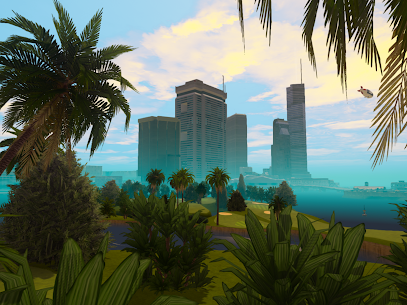
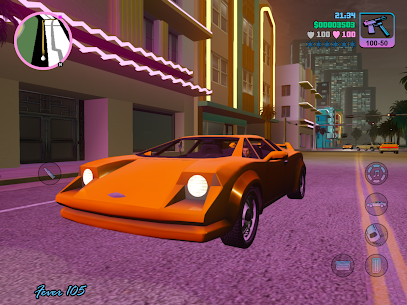
The Definitive Edition utilizes Unreal Engine 4 to render this world with a fidelity impossible on the PlayStation 2. The most immediate change is the lighting. The sun no longer just illuminates; it saturates. Golden Hour in the Definitive Edition is a sight to behold, with long dynamic shadows stretching across the tarmac and real-time reflections dancing off the hoods of sports cars. At night, the city transforms into a kaleidoscope of pink, teal, and purple neon. The wet asphalt effect, while initially controversial for being too glossy, has been tuned in the mobile version to provide a rain-slicked aesthetic that perfectly captures the “tropical noir” vibe.
Cultural Pastiche and Satire
The writing of Vice City remains untouched, preserving the biting satire that Rockstar is famous for. The game is a pastiche of 80s pop culture, drawing heavily from Scarface, Carlito’s Way, and naturally, Miami Vice. The Definitive Edition keeps every line of dialogue, every satirical radio ad, and every absurd pedestrian interaction intact.
However, the transition to a modern engine has altered the “vibe” in subtle ways. The original game utilized a distinct “trails” effect and a heavy distance fog to hide technical limitations. This inadvertently gave the game a hazy, dreamlike, humidity-soaked atmosphere that felt like a fever dream. The Definitive Edition largely removes this fog, allowing players to see from one end of the map to the other. While technically impressive, this “clean” look sometimes robs the city of its scale, making the islands feel smaller and more toy-like than they did in our memories. You can now see the skyscrapers of Downtown clearly from the beach, which breaks the illusion of a sprawling metropolis slightly.
The Saga of Tommy Vercetti
The Protagonist
At the center of the chaos is Tommy Vercetti, voiced by the late, legendary Ray Liotta. Vercetti was a departure from the silent protagonist (Claude) of GTA III. He is vocal, angry, intelligent, and ruthless. Liotta’s performance is iconic, bringing a level of Hollywood gravitas that was unheard of in video games at the time. Tommy is not just a thug; he is a force of nature, a man betrayed by his own “family” who decides to take everything for himself. His journey from a Hawaiian-shirt-wearing ex-con to the suit-wearing drug lord of the south is one of the best character arcs in the franchise.
The Supporting Cast and Character Models
The narrative is bolstered by a cast of eccentric, memorable characters that define the GTA formula.
- Ken Rosenberg: The neurotic, cocaine-addicted lawyer (voiced by William Fichtner) serves as Tommy’s guide and comic relief, channeling Sean Penn’s character from Carlito’s Way.
- Lance Vance: The smooth-talking partner with a chip on his shoulder (voiced by Philip Michael Thomas of Miami Vice fame), whose tragic arc mimics the betrayals of classic mob cinema.
- Ricardo Diaz: The paranoid drug lord whose mansion eventually becomes Tommy’s palace.
In the Definitive Edition, these characters have received new 3D models. This has been the source of significant debate. The art style leans towards a “caricature” aesthetic—smoothing out skin textures and exaggerating features—which can sometimes result in characters looking like action figures or “plastic” dolls rather than gritty criminals. Ken Rosenberg looks appropriately sweaty and nervous, but other characters, like the mechanic Phil Cassidy, have lost some of the rugged detail that defined their original appearance. While the facial animations are more fluid, allowing for better lip-syncing and expression during cutscenes, the stylistic shift can be jarring for purists who preferred the sharper, grittier look of the original textures.
Gameplay Evolution
The most significant argument for playing the Definitive Edition over the original lies in the gameplay. The 2002 release, while revolutionary, suffers from archaic controls that can be difficult for modern gamers to tolerate. The Definitive Edition modernizes the experience significantly, making it accessible to a new generation.
The “GTA V” Control Scheme
Rockstar has implemented a control scheme inspired by Grand Theft Auto V, bridging the gap between generations.
- Gunplay and Targeting: The lock-on system has been completely overhauled. In the original, targeting was a gamble; Tommy would often lock onto a pedestrian fifty feet away while an enemy with a shotgun stood right in front of him. The Definitive Edition offers a snappy, reliable lock-on system with the ability to switch targets with a flick of the right stick. Free-aiming is now standard, making precision shooting viable.
- The Weapon Wheel: The clumsy inventory scrolling of the past is replaced by a modern weapon wheel. This allows players to visualize their arsenal and switch weapons instantly, slowing down time slightly to allow for tactical decisions during combat. It makes switching from a submachine gun to a rocket launcher feel fluid and cinematic.
- Drive-By Shooting: Perhaps the biggest gameplay improvement is the drive-by mechanic. Players can now aim freely out of the window, offering 360-degree coverage rather than the simple “look left/look right” toggle of the original. This makes chase missions significantly more dynamic and fun.
Navigation and User Interface
The Mini-Map has been upgraded with a GPS system. Players can set waypoints on the main map, and the radar will generate a legal path to the destination. This sounds minor, but in a city full of winding bridges and dead ends, it is a massive quality-of-life improvement. Additionally, the user interface has been cleaned up with high-resolution icons and text, making it legible on high-density mobile screens. The HUD colors have been tweaked to pop against the brighter environments, maintaining the game’s signature pink and blue aesthetic.
The Checkpoint System
The original Vice City was punishing. Failing a mission often meant losing all your weapons, waking up at a hospital, driving back to the mission giver, and restarting from scratch. The Definitive Edition introduces mission checkpoints. If you die during a multi-stage mission (like the infamous bank heist “The Job”), the game prompts you to restart from the last major checkpoint with full health and ammo. This respects the player’s time and removes the most frustrating friction of the classic design, allowing players to experiment with different strategies without the fear of a 15-minute punishment loop.
The Mobile Experience (Android & iOS)
The link provided directs to the mobile version of the game, which is distinct from the console versions in several key ways. Interestingly, the mobile version is widely considered the superior way to play the Definitive Edition.
Delayed Polish and Netflix Games
The mobile version arrived significantly later than the console launch. This delay allowed the developers to address hundreds of bugs that plagued the initial release. Furthermore, the inclusion of the game in the Netflix Games library brought it to a massive audience, necessitating a higher level of polish. The mobile build feels more stable, with fewer crashes and glitchy physics than the day-one console versions.
Exclusive Features: Classic Lighting
A standout feature of the mobile version is the “Classic Lighting” mode. Toggled in the settings, this mode alters the color grading and skybox to closely mimic the original PS2 palette. It brings back the warmer, hazier look of the 2002 release, effectively fixing the “too clean” criticism leveled at the console versions. This feature alone makes the mobile version the preferred choice for nostalgia seekers, as it bridges the gap between the new assets and the old atmosphere.
Touch Controls vs. Controller Support
Rockstar has a long history of successful mobile ports, and the touch controls here are fully customizable.
- Virtual Joysticks: Players can move and resize the virtual analog sticks and buttons to suit their hand size and grip style. The default layout is intuitive, with separate buttons for shooting, entering vehicles, and sprinting.
- Haptic Feedback: The game utilizes the vibration motors of modern phones to provide tactile feedback when driving over rough terrain or firing weapons. It adds a surprising amount of immersion to the handheld experience.
- Controller Support: For the “definitive” experience, the game supports Bluetooth controllers (Xbox, PlayStation, etc.). Playing on an iPad or a high-end Android tablet with a PS5 controller feels almost indistinguishable from a console experience.
Performance
On high-end devices (Snapdragon 8 Gen 2/3, A16/A17 Bionic), the game runs smoothly, targeting 30fps or 60fps depending on settings. However, it is a demanding title. It requires significant storage space (approx. 6-8GB) and can heat up older devices quickly. The “Resolution” slider in the settings allows players to balance visual fidelity with performance, a necessary feature for the fragmented Android ecosystem.
Visuals – A Mixed Bag
The Unreal Engine Upgrade
Moving Vice City from the RenderWare engine to Unreal Engine 4 was a massive undertaking.
- Textures: Almost every texture in the game has been upscaled or replaced. Walls have bump mapping, roads have grain, and clothing has fabric textures. You can read the labels on products in store windows, and the interior of the Ocean View Hotel looks suitably tacky and detailed.
- Reflections: Real-time reflections on vehicles and glass add a layer of depth to the world. Seeing the neon Hotel signs reflected in the hood of your Infernus as you speed down the strip is a visual highlight that simply wasn’t possible in 2002.
- Foliage: The flat, cross-hatched trees of the PS2 era are gone, replaced by actual 3D models of palms and bushes that sway in the wind. This makes the city feel lush and overgrown, more like the real Miami.
The “Plastic” Controversy
Despite the technical improvements, the art direction remains the game’s most divisive element. The attempt to blend the original’s low-poly geometry with modern lighting results in an uncanny aesthetic. Characters often look too smooth, and the environmental lighting can sometimes be too bright, washing out the mood. While patches have improved this, especially with the Classic Lighting mode, the game never quite captures the gritty, dirty aesthetic of the original promotional art. It looks more like a high-fidelity cartoon than a gritty crime drama.
The Soundtrack and Audio
The Music
Vice City arguably has the greatest licensed soundtrack in video game history. It defined the taste of a generation. The Definitive Edition retains the vast majority of this soundtrack. Cruising down the beach listening to “Broken Wings” by Mr. Mister or “Dance Hall Days” by Wang Chung is as magical as ever. The radio stations (Flash FM, V-Rock, Wave 103, etc.) are time capsules, complete with hilarious DJ banter that satirizes the era’s excesses.
- Missing Tracks: It must be noted that due to licensing expirations, a few tracks are missing (e.g., “Billie Jean” by Michael Jackson, “Bark at the Moon” by Ozzy Osbourne). While their absence is felt by purists, the remaining library is so vast that new players likely won’t notice. The soul of the soundtrack remains intact.
Sound Design
The audio mix has been adjusted, but some players report that the sound effects (gunshots, car engines) sound compressed or “muffled” compared to the crispness of the original PC version. The voice acting, however, remains untouched and perfect. The environmental audio—the sound of waves crashing, distant sirens, and pedestrians shouting—has been spatialized, sounding excellent on modern headphones.
Iconic Missions and Moments
The Definitive Edition allows us to revisit some of the most memorable (and frustrating) missions in gaming history with new mechanics.
- Demolition Man: The infamous RC Helicopter mission. In the original, this was a controller-smashing nightmare due to poor controls and a strict timer. In the Definitive Edition, the improved physics and refined controls make it significantly more manageable, turning a source of trauma into a fun, if still challenging, puzzle.
- The Driver: Racing against Hilary King was notoriously unfair in 2002. The improved driving physics and frame rate in the Definitive Edition make the Sentinel car feel heavier and more responsive, making this race a test of skill rather than luck.
- Keep Your Friends Close: The explosive finale at the Vercetti Estate benefits greatly from the modern aiming controls, turning what was once a chaotic mess of auto-aim failures into a satisfying third-person shooter set piece.
- Asset Missions: Buying businesses (The Malibu Club, The Cherry Popper Ice Cream Factory) and completing their specific mission strands remains the core loop of the mid-game. The Definitive Edition makes managing these assets easier with better map markers and clear objective text.
Conclusion: The Verdict
Grand Theft Auto: Vice City – The Definitive Edition is a complex product. It is a collision of a 20-year-old masterpiece and modern technology, and the results are not always harmonious. The art style is inconsistent, and the ghost of its buggy launch still haunts the discourse.
However, specifically regarding the mobile version, the verdict is surprisingly positive.
- It is the most polished version: The mobile release benefited from the post-launch patches of the console versions, resulting in a more stable experience.
- Classic Lighting: This exclusive feature restores the atmosphere that fans craved, making it the most visually faithful way to play the remaster.
- Accessibility: The quality-of-life improvements (checkpoints, GPS, weapon wheel) make the game infinitely more playable for a modern audience who might not have the patience for 2002 design frustrations.
Is it worth playing? Absolutely. Despite its visual quirks, the core of Vice City—the loop of earning money, buying property, and taking over the town—remains undeniably addictive. The writing is still hilarious, the music is still perfect, and the feeling of owning the city is unmatched. For new players, this is the most accessible way to experience a classic. For veterans, it’s a chance to see an old friend in a new (and slightly expensive) suit.
If you have a capable Android or iOS device, GTA: Vice City – The Definitive Edition is a robust, expansive open-world experience that fits in your pocket, offering dozens of hours of gameplay that defined a generation. It serves as a reminder of why Rockstar Games became the titan it is today.
What's new
General fixes and improvements.
Download links
An ad will pop up before the download. Close it, click download again—ads keep us going, thanks!