
Geometry Dash

Geometry Dash MOD APK Info
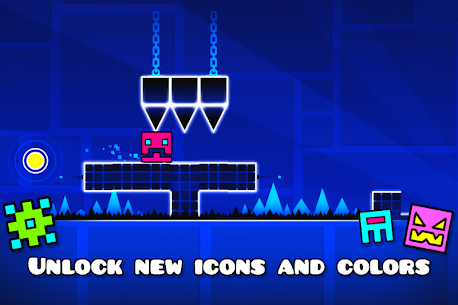
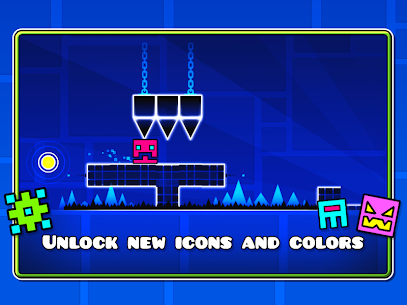
The Geometry Dash Mod APK transforms the standard gameplay experience by removing progression barriers for casual and hardcore players alike. This modified version provides Unlimited Currency (such as Mana Orbs and Diamonds), allowing users to instantly unlock every icon, ship, and color trail without the need for extensive grinding. Additionally, the Unlocked status grants immediate access to all official levels, including the challenging Demon stages, and fully unlocks the level editor’s capabilities, ensuring players can enjoy the complete creative and competitive scope of the game right from the start.
Images
Related apps



Description
In the vast, often ephemeral world of mobile gaming, few titles manage to maintain relevance for more than a few months. Even fewer survive for a decade. Geometry Dash, however, has not only survived since its 2013 release—it has thrived, evolving from a simple distraction into a complex esport, a creative engine, and a cultural touchstone for millions of players. Developed by a single man, Robert Topala (known as RobTop), this rhythm-based platformer has transcended its genre to become a digital canvas where music, reflex, and art collide.
Table of Contents
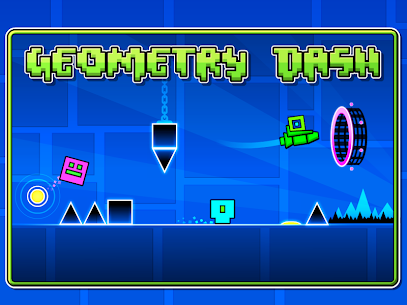
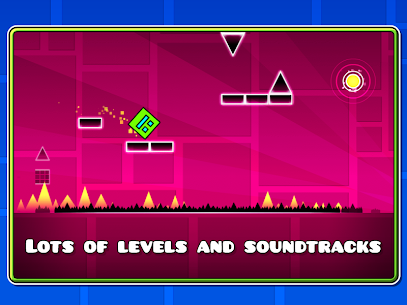
At its core, Geometry Dash is deceptively simple: you are a square icon moving automatically to the right. You tap to jump. If you hit a spike or a wall, you die and restart instantly. But beneath this elementary premise lies a game of infinite depth, fueled by a level editor that has allowed the community to build challenges far exceeding the developer’s original vision. This article explores the history, mechanics, and unparalleled community impact of Geometry Dash.
1. Origins: The One-Man Army
To understand Geometry Dash, one must understand its creator. Robert Topala, a Swedish developer, began his journey in game design with a passion for platformers like Super Mario Bros. and the “impossible game” genre that was popular in the early 2010s. Before Geometry Dash, Topala released a puzzle game called Boomlings under his studio, RobTop Games.
In 2013, inspired by titles like The Impossible Game and Bit.Trip Runner, Topala began working on a project initially titled Geometry Jump. His goal was to create a platformer that was not just difficult, but rhythmically satisfying. The game was built on the Cocos2d-x engine, a framework that would later be pushed to its absolute limits by the community.
On August 13, 2013, Geometry Dash was released on iOS and Android. It launched with just seven levels, ending with “Jumper.” The early versions were primitive by modern standards—simple block structures, basic scrolling backgrounds, and no custom music integration. Yet, the core loop was addictive. The “one more try” mentality, coupled with the instant respawn mechanic, hooked players immediately.
Over the next year, Topala released a flurry of updates (1.0 to 1.5), adding new levels like “Time Machine” and “Clutterfunk,” as well as new game modes like the gravity-flipping ball and the flying ship. However, the true turning point came with update 1.9 in late 2014, widely considered the “Golden Age” of the game’s early history. This update introduced the custom music system via Newgrounds, effectively giving players access to an infinite library of songs and birthing the modern user-level scene.
2. Gameplay Mechanics: The Art of Flow
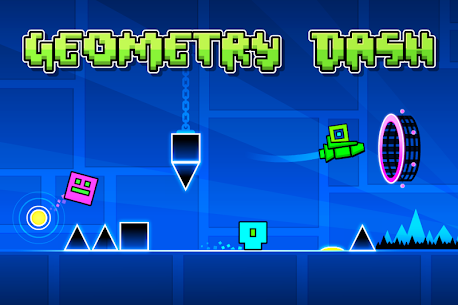
On the surface, Geometry Dash is a one-button game. On mobile, you tap the screen; on PC, you click the mouse or press the spacebar. However, the complexity comes from how this single input interacts with the various “Portals” and “Gamemodes” that transform the player’s icon.
The Gamemodes
The game currently features eight distinct vehicles, each with unique physics:
- The Cube: The default mode. Tapping makes the icon jump. Holding allows for repeated jumps, but precise timing is usually required to clear spikes or gaps.
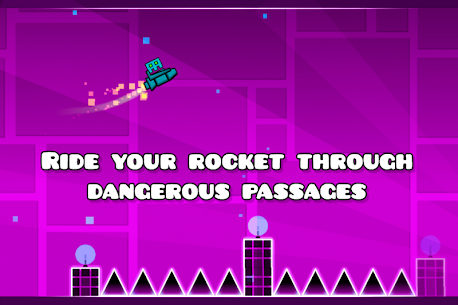
- The Ship: Introduced early on, the ship flies upward when you hold the input and falls when you release. It behaves like Flappy Bird but with significantly more momentum and physics weight.
- The Ball: This mode flips gravity. When you click, the ball shifts from the floor to the ceiling (or vice versa). There is no mid-air control; you must be on a surface to switch gravity.
- The UFO: Based on Flappy Bird mechanics but with a distinct twist. Each click provides a small, fixed mid-air jump (a “flap”). It requires rhythm and counting clicks rather than holding.
- The Wave: Often considered the most high-skill gamemode. The wave moves diagonally upward when held and diagonally downward when released. It creates a zigzag motion that allows for extremely tight corridors and fast-paced gameplay.
- The Robot: Similar to the Cube, but the duration of your click determines the height of the jump. A short tap is a hop; a long hold is a massive leap. This adds an analog feel to the digital input.
- The Spider: Similar to the Ball, but instead of traveling through the air to the other side, the Spider teleports instantly to the opposing surface. This eliminates travel time, demanding instantaneous reaction speeds.
- The Swing: Officially added in Update 2.2, the Swing acts like a mix of the Ship and the Ball. It flies in mid-air, but clicking reverses gravity, causing it to loop and curve in arcs.
Portals and Modifiers
To compound the difficulty, levels are filled with portals that alter the game state:
- Speed Portals: Change the scrolling speed of the level (Slow, Normal, Fast, Very Fast, and Super Fast).
- Gravity Portals: Flip the entire game upside down.
- Size Portals: Shrink the icon to a “Mini” version, altering the physics (e.g., the mini-Cube jumps lower; the mini-Wave moves sharper).
- Mirror Portals: Reverse the screen so the player moves from right to left, a disorienting effect that tests muscle memory.
- Dual Mode: Splits the icon into two separate entities. Depending on the level design, the player might control both simultaneously with one input, or control them independently in 2-player mode.
The “flow” state in Geometry Dash is achieved when a player internalizes these mechanics to the point where they are no longer thinking about the controls, but rather “feeling” the music.
3. The Difficulty System: From Auto to Extreme
Geometry Dash uses a star-rating system to categorize difficulty. RobTop manually “rates” user levels, awarding them stars ranging from 1 to 10.
- Auto (1 Star): The level plays itself; the player just watches the visuals.
- Easy to Insane (2-9 Stars): The standard progression of difficulty.
- Demon (10 Stars): The coveted “Demon” rating is reserved for the hardest levels.
The Demon Hierarchy
Because the skill ceiling of the community rose so rapidly, a single “Demon” rating became insufficient. The community, and later the game itself, subdivided Demons into five tiers:
- Easy Demon: Challenging for beginners, but accessible (e.g., “The Nightmare”).
- Medium Demon: Requires memorization and decent ship/wave control.
- Hard Demon: A significant step up, often requiring days of practice for average players.
- Insane Demon: Near-professional level difficulty.
- Extreme Demon: The apex of difficulty. These levels often require thousands, sometimes hundreds of thousands, of attempts to beat.
Levels like “Bloodbath,” “Slaughterhouse,” and “Acheron” fall into the Extreme Demon category. They are not just hard; they are pixel-perfect gauntlets that require perfection for minutes on end.
4. The Level Editor: A Game Engine Within a Game
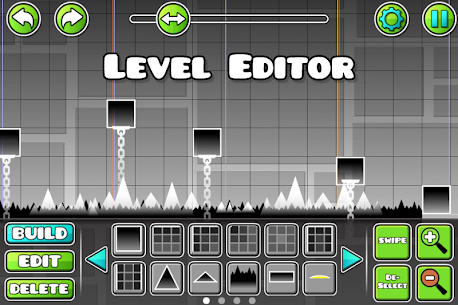
The true genius of Geometry Dash is its Level Editor. It is surprisingly robust, offering tools that rival professional game engines.
Triggers and Logic
What started as placing blocks and spikes has evolved into a visual programming language.
- Move/Rotate/Scale Triggers: Allow objects to move and animate, creating dynamic environments.
- Pulse/Color Triggers: Sync the visual environment to the music.
- Alpha/Toggle Triggers: Make objects invisible or toggle their collision, allowing for complex “gimmicks” and fake-outs.
- The 2.2 Camera Controls: The latest update added the ability to zoom the camera, rotate the viewport, and detach the camera from the player, allowing for cinematic storytelling.
Decoration (“Deco”)
Community creators have pushed the visual limits of the engine. Early levels (1.0-1.6) were purely gameplay-focused. The 1.9 update introduced “decoration blocks,” leading to the “Design Era.” Today, levels are judged on their “Art Style.” We have levels that look like modern art (Modern style), levels that look like glow-drenched neon cities (Glow style), and levels that use thousands of objects to recreate 3D engines or play full-video animations.
The “Object Limit” (originally 40,000, now 80,000+) is frequently bypassed by creators using optimization hacks to place hundreds of thousands of objects, turning simple mobile phone screens into melting pots of particle effects.
5. The Community: Competition and Culture
The Geometry Dash community is one of the most active and dedicated in gaming. It operates largely on YouTube, Discord, and Twitch.
The Demon List
The “Pointercrate Demon List” is the unofficial-official ranking of the hardest levels in the game. It is the bible of the competitive scene. When a new “Top 1” level is verified, it is a massive event.
- The Bloodbath Era: In 2015, the player Riot verified “Bloodbath,” a level so difficult it was deemed impossible by many. It held the #1 spot for months and remains the most iconic level in the game’s history.
- The SpaceUK Controversy: In 2023, the community was rocked when SpaceUK, a player considered the greatest of all time (having beaten the entire Top 75 Demons), was exposed for hacking. He had used a “bot” to slow down the game and splice runs together. This scandal led to a massive overhaul in how records are verified, with players now required to record their mouse clicks and hand movements (handcams) to prove legitimacy.
- Current Titans: Players like Zoink have pushed the human limit further than thought possible, verifying levels like “Tidal Wave” that move at speeds the human eye can barely track.
The Verification System
A unique rule in Geometry Dash is that to upload a level, the creator (or a designated verifier) must beat it from start to finish. You cannot upload a level that is impossible. This rule ensures that every level on the server, no matter how hard, is theoretically beatable. This creates a “Proving Ground” culture where creators build levels slightly above their skill limit and spend months trying to “verify” them.
6. Music: The Heartbeat of the Game
Unlike other rhythm games that license famous pop songs, Geometry Dash relies on independent artists, primarily from Newgrounds.
- The Big Names: Artists like Waterflame, F-777, MDK, DJVI, and TheFatRat have become synonymous with the game. Their tracks—typically high-energy Techno, Dubstep, or Drum & Bass—provide the adrenaline needed for the gameplay.
- Sync: Good gameplay is defined by “sync”—how well the clicks align with the kick drums, snares, and melodies of the song. A level with bad sync is often disliked, regardless of how good it looks.
- The Newgrounds Integration: By allowing players to use any song from the Newgrounds audio portal (with artist permission), RobTop outsourced the soundtrack to the internet. This gave the game an infinite lifespan, as new music genres (like Kawaii Future Bass or Breakcore) entered the game naturally as they became popular online.
7. The Wait for 2.2: A Test of Loyalty
Update 2.1 was released in January 2017. Update 2.2 was released in December 2023. For nearly seven years, the community waited for a single update. In the modern gaming industry, a seven-year content drought usually kills a game. For Geometry Dash, it did the opposite.
Forced to rely on their own creativity, the community stretched the 2.1 editor to its breaking point. They created “unofficial” 2.2 features using bugs and glitches. They organized massive collaboration levels (“Megacollabs”) that took years to build. The wait for 2.2 became a meme, a shared trauma, and a bonding experience.
The 2.2 Revolution
When Update 2.2 finally launched, it changed everything:
- Platformer Mode: For the first time, players could move left and right freely, turning the game into a traditional platformer like Celeste or Mario.
- Camera Controls: The static camera was gone. The camera could now zoom out to show massive bosses or zoom in for intense tight spaces.
- New Icons and Mechanics: The Swing copter, the jetpack, and hundreds of new icons were added.
- Shader Effects: The ability to warp the screen, add glitches, and apply filters (like CRT or sepia) natively.
The update was massive, effectively doubling the game’s possibilities and securing its future for another decade.
8. Spin-offs and The Future
RobTop has released three spin-off mobile apps, largely to keep the brand alive during the long development cycles:
- Geometry Dash Meltdown: Features three levels with a heavy focus on visual effects and music by F-777.
- Geometry Dash World: A shorter, bite-sized experience focusing on “featured” user levels and daily rewards.
- Geometry Dash SubZero: Showcased early 2.2 features (like camera controls) years before the main update, teasing players with what was to come.
As for the future, the release of 2.2 has sparked a renaissance. “Platformer Mode” has created a new sub-community of speedrunners. The “Lists” (Demon List, Challenge List, Platformer List) are more active than ever.
Geometry Dash is no longer just a game; it is a sport, an art form, and a community. It proves that you don’t need 4K photorealistic graphics or a AAA studio budget to capture the hearts of millions. You just need a cube, a catchy song, and the drive to try again.
Key Statistics
- Developer: RobTop Games (Robert Topala)
- Release Date: August 13, 2013
- Engine: Cocos2d-x
- Official Levels: 26 (as of 2.2)
- User Levels: Over 100 million
- Platforms: iOS, Android, Steam (PC/Mac)
Famous Terms Glossary
- Buff: To make a level harder.
- Nerf: To make a level easier.
- Silent: A term used for levels that are historically impossible or near-impossible (e.g., “Silent Clubstep”).
- Nine Circles: A style of level design featuring a flashing epilepsy-inducing wave effect, popularized by the level “Nine Circles” by Zobros.
- Straight Fly: A technique in the Ship gamemode requiring the player to hold the ship in a perfectly straight line through tight spikes.
What's new
Update 2.2.144 Patch Notes: - Event levels and chests! - New achievements and rewards - New song trigger options - Bugfixes and optimizations - Secrets...
Video
Download links
An ad will pop up before the download. Close it, click download again—ads keep us going, thanks!


